
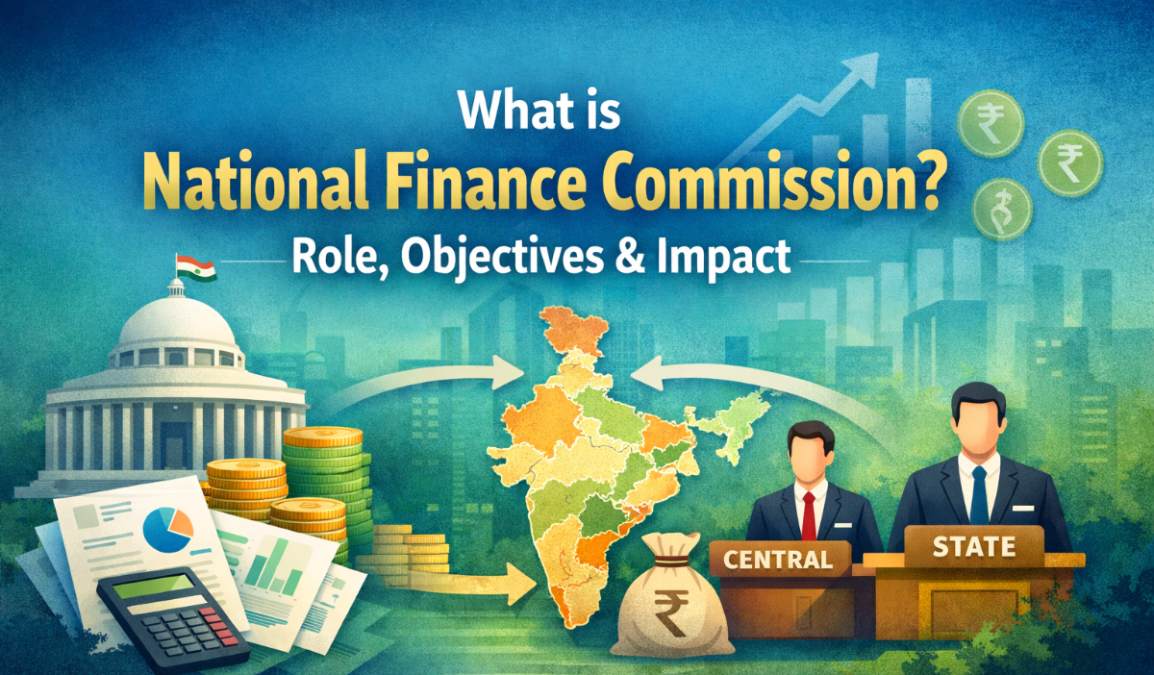
What is National Finance Commission? – When we talk about how money flows within a country, especially between the central government and state or provincial governments, one important institution comes into play — the National Finance Commission (NFC). It may not be a term people use every day, but its decisions affect everything from infrastructure development to public services like healthcare and education.
In simple terms, the National Finance Commission is responsible for deciding how financial resources, especially tax revenues, are distributed among different levels of government. This ensures that all regions receive a fair share of funds to function effectively.
In this blog, we’ll break down what the National Finance Commission is, how it works, its key roles, objectives, and the real impact it has on a country’s economic balance.
What is the National Finance Commission?
The National Finance Commission (NFC) is a constitutional body formed by the central government to manage the distribution of financial resources between the federal government and the states or provinces.
It is typically established at regular intervals (for example, every 5 years in some countries) and includes representatives from both central and regional governments. The main purpose of the commission is to recommend how taxes collected at the national level should be shared.
The idea behind creating such a commission is simple — while the central government collects most of the taxes, state governments are responsible for delivering many essential services. Without a fair system of distribution, regional inequality can grow rapidly.
Why is the National Finance Commission Important?
The importance of the National Finance Commission lies in its ability to maintain financial balance and cooperative federalism.
Here’s why it matters:
- It reduces financial gaps between richer and poorer regions
- It ensures that state governments have enough funds to operate
- It promotes fairness in resource allocation
- It supports national unity by reducing regional disparities
Without a structured system like the NFC, wealth would remain concentrated in certain areas, leaving others underdeveloped.
Structure of the National Finance Commission
Although the structure can vary by country, a typical National Finance Commission includes:
- A Chairperson appointed by the central government
- Finance ministers or representatives from each state/province
- Economic and financial experts
- Government officials with experience in public finance
This mix ensures that both political and technical perspectives are considered while making decisions.
Key Functions of the National Finance Commission
The National Finance Commission performs several crucial functions that directly influence a country’s fiscal health.
1. Distribution of Tax Revenues
One of the main functions of the NFC is to decide how tax revenues collected by the central government are shared with states.
This includes:
- Income tax
- Goods and services tax (GST)
- Corporate taxes
The commission creates a formula based on factors like population, income level, and development needs.
2. Grants-in-Aid Allocation
Apart from tax sharing, the NFC also recommends grants-in-aid for states that need additional financial support.
These grants are especially important for:
- Less developed regions
- States with budget deficits
- Areas facing natural disasters
3. Reducing Regional Imbalance
The commission plays a major role in addressing economic inequality between regions.
By allocating more funds to underdeveloped areas, it helps:
- Improve infrastructure
- Boost employment
- Enhance public services
4. Advising on Fiscal Matters
The NFC also provides recommendations on broader fiscal issues, such as:
- Debt management
- Fiscal discipline
- Resource mobilization
These suggestions help governments maintain financial stability.
Objectives of the National Finance Commission
The National Finance Commission is not just about distributing money — it works with clear long-term goals.
1. Ensuring Fair Distribution of Resources
The primary objective is to create a fair and transparent system for sharing revenues among different levels of government.
2. Promoting Balanced Regional Development
The NFC aims to reduce the gap between developed and underdeveloped regions by allocating resources strategically.
3. Strengthening Federal Structure
By involving both central and state governments, the commission promotes cooperative federalism, where all levels work together.
4. Encouraging Fiscal Responsibility
The commission also encourages governments to manage their finances responsibly by setting guidelines and conditions.
5. Supporting Public Welfare
Ultimately, the goal is to ensure that citizens across all regions receive equal access to essential services.
How Does the National Finance Commission Work?
The working process of the NFC usually follows a structured approach:
Step 1: Data Collection
The commission collects economic data such as:
- State income levels
- Population statistics
- Tax collection figures
Step 2: Consultation
It consults with:
- State governments
- Financial experts
- Policy advisors
Step 3: Formula Creation
Based on the data, the commission develops a resource-sharing formula.
Common factors include:
- Population
- Area
- Fiscal capacity
- Development index
Step 4: Recommendations
The commission submits its recommendations to the central government.
Step 5: Implementation
Once approved, the recommendations are implemented for a fixed period.
Impact of the National Finance Commission
The decisions made by the NFC have a far-reaching impact on a country’s economy and governance.
1. Improved Public Services
When states receive adequate funds, they can invest in:
- Healthcare
- Education
- Infrastructure
2. Reduced Regional Inequality
By directing funds to weaker regions, the NFC helps bridge the development gap.
3. Economic Stability
A fair distribution system ensures that no region faces extreme financial stress, contributing to overall economic stability.
4. Better Governance
With proper funding, state governments can function more efficiently and deliver better services.
5. Boost to Local Development
Funds allocated through the NFC often reach local bodies, supporting grassroots development.
Challenges Faced by the National Finance Commission
Despite its importance, the NFC faces several challenges:
1. Political Pressure
Decisions may be influenced by political considerations rather than pure economic logic.
2. Data Accuracy Issues
Reliable and up-to-date data is essential, but not always available.
3. Balancing Equity and Efficiency
Allocating funds fairly while ensuring efficient use is a complex task.
4. Implementation Gaps
Even well-designed recommendations may face issues during execution.
National Finance Commission vs Finance Commission
Many people confuse the National Finance Commission with the Finance Commission (like in India).
- The Finance Commission is a constitutional body in India
- The term National Finance Commission is more commonly used in countries like Pakistan
However, both serve a similar purpose — distributing financial resources between central and state governments.
Real-World Example (Simple Understanding)
Imagine a country where the central government collects most taxes. Some states are rich and developed, while others are still growing.
Without the NFC:
- Rich states would continue to grow
- Poor states would struggle
With the NFC:
- Funds are distributed fairly
- Poor states get extra support
- Overall development becomes balanced
Future of the National Finance Commission
As economies grow more complex, the role of the NFC will become even more important.
Future improvements may include:
- Use of real-time data analytics
- Greater transparency in decision-making
- Inclusion of environmental and sustainability factors
- Performance-based funding models
Conclusion
The National Finance Commission is a vital institution that ensures fairness in a country’s financial system. By distributing resources wisely, it helps maintain balance, promote development, and support good governance.
Its role goes beyond numbers — it directly impacts the quality of life of citizens by enabling better public services and reducing inequality.
Understanding how the National Finance Commission works gives us a clearer picture of how governments manage resources and strive for inclusive growth.
