
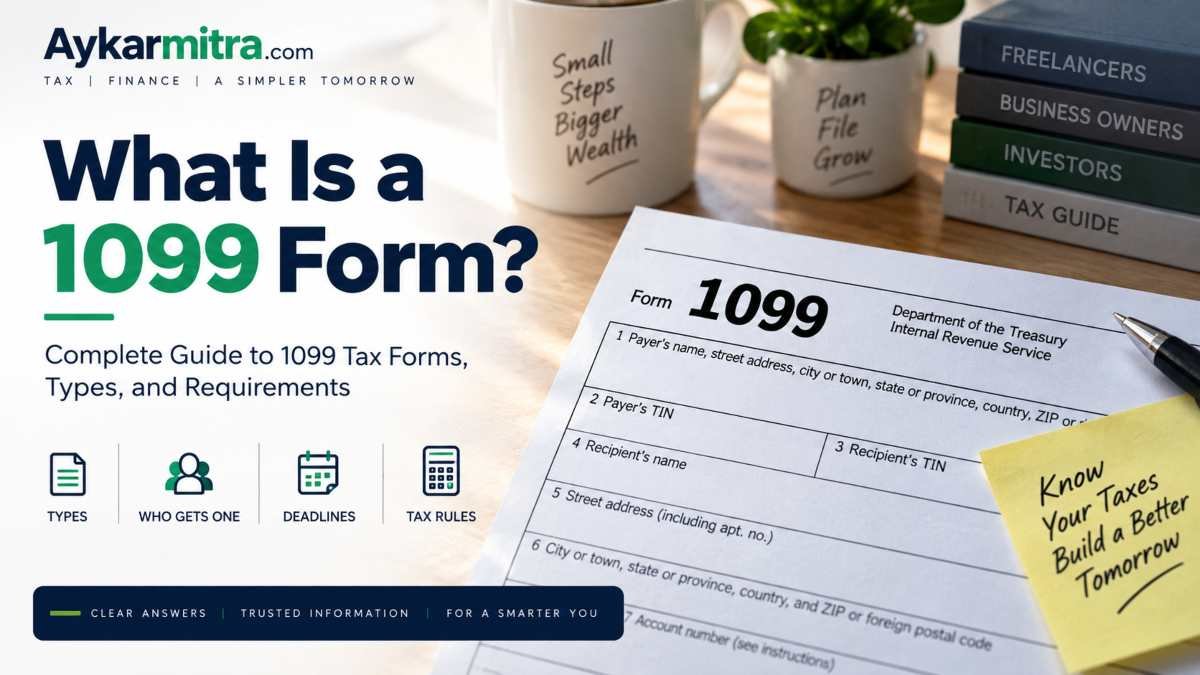
If you work as an independent contractor, freelancer, business owner, investor, or receive certain types of payments in the United States, you may come across a 1099 form during tax season.
But what is a 1099 form, and why do you receive one?
A 1099 is generally an information return used to report certain payments and types of income to the IRS. Unlike a W-2, which is normally used to report wages paid to employees, different 1099 forms are used for different kinds of income and payments.
Receiving a 1099 does not automatically mean you owe tax on the exact amount shown. Instead, the form gives you and the IRS information about payments that may need to be reported on your tax return.
Quick Facts About a 1099 Form
| Detail | Information |
|---|---|
| What is a 1099? | An IRS information return used to report certain payments and income |
| Who may receive one? | Freelancers, contractors, investors, taxpayers receiving certain government payments, and others |
| Who issues it? | Businesses, financial institutions, government agencies, and other qualifying payers |
| Is a 1099 the same as a W-2? | No. A W-2 generally reports employee wages, while 1099 forms report various other types of payments or income |
| Does receiving a 1099 mean the income is taxable? | The amount may need to be considered when preparing your tax return, depending on the type of income and applicable tax rules |
| Common forms | 1099-NEC, 1099-MISC, 1099-K, 1099-INT, 1099-DIV, 1099-G and 1099-R |
| When are forms generally received? | Many information returns are furnished in January or February, although deadlines vary by form |
| Who receives a copy? | Generally, the recipient receives a statement while the payer reports applicable information to the IRS |
The IRS explains that 1099 forms are used for various types of income other than regular employee wages. Common examples include payments reported on Forms 1099-K and 1099-G.
Read Also: FMGE October 2026: Exam Date, Application Form, Eligibility, Syllabus & Latest Updates
What Is a 1099 Form?
A 1099 form is an IRS information return that reports certain payments or income received during the year.
There isn’t just one type of 1099. The IRS uses a series of 1099 forms, with each form designed for particular types of payments.
For example, a person who performs services as an independent contractor may receive a Form 1099-NEC, while someone receiving certain interest income may receive a Form 1099-INT.
The information reported on the form is also generally provided to the IRS. This allows the IRS to compare information reported by payers with information included on taxpayers’ returns.
It’s important to understand that a 1099 is primarily a reporting document. It isn’t a bill from the IRS and it doesn’t mean that the amount shown is automatically the amount of tax you owe.
Why Do You Receive a 1099 Form?
You may receive a 1099 when you receive a type of payment that a business, financial institution, government agency, or another payer is required to report.
For example, you could receive a 1099 if you:
- Work as an independent contractor
- Receive certain interest income
- Receive dividends or other investment-related payments
- Receive certain government payments
- Receive qualifying payments through payment cards or online marketplaces
- Receive certain retirement distributions
- Receive specific miscellaneous payments
The exact reporting requirement depends on the type of payment, the payer, the recipient, and the applicable IRS rules.
The IRS states that organizations and individuals making reportable payments may have to provide information returns to recipients and report the information to the IRS.
Read Also: What Are Derivatives in Finance? Types, Uses, Benefits & Risks
What Are the Most Common Types of 1099 Forms?
Because there are many forms in the 1099 series, it is useful to understand the most common ones.
1099-NEC
Form 1099-NEC is generally used to report nonemployee compensation.
This is particularly important for freelancers, independent contractors, and other self-employed people who receive payments for services.
For 2026 reporting, the IRS instructions specify a $2,000 reporting threshold for certain nonemployee compensation payments made in the course of a trade or business. The form is generally due to the IRS by January 31, subject to the applicable next-business-day rule when the date falls on a weekend or legal holiday.
1099-MISC
Form 1099-MISC is used for certain miscellaneous payments, including qualifying rent, royalty, prize, award, and other payments.
The reporting thresholds depend on the type of payment. For example, the IRS’s 2026 instructions list different thresholds for different categories of payments rather than applying one universal threshold to every 1099-MISC payment.
1099-K
Form 1099-K is generally associated with payments received through payment cards and certain third-party payment networks.
This can be particularly relevant to people who sell goods or services through online marketplaces or payment platforms.
It’s important not to assume that every payment appearing on a payment platform is automatically taxable income in the same way. The nature of the transaction still matters when preparing a tax return.
1099-INT
Form 1099-INT is generally used to report certain interest income.
For example, a bank or other financial institution may issue this form when applicable interest-reporting requirements are met.
1099-DIV
Form 1099-DIV is generally used to report certain dividends and distributions from investments.
Investors may receive this form from a brokerage or other financial institution when applicable reporting requirements are met.
1099-G
Form 1099-G can report certain government payments, including certain unemployment compensation.
The specific amount and type of payment reported determine how it should be handled on a tax return.
1099-R
Form 1099-R is generally used for certain distributions from pensions, annuities, retirement plans, and similar arrangements.
The tax treatment can vary depending on the nature of the distribution and the taxpayer’s circumstances.
1099 Form vs. W-2: What’s the Difference?
One of the easiest ways to understand a 1099 is to compare it with a W-2.
A W-2 generally reports wages paid by an employer to an employee, while 1099 forms cover a much broader range of payments and income.
For example, if you work as a regular employee, your employer generally reports your wages on Form W-2. If you operate as an independent contractor and receive qualifying payments for services, you may receive Form 1099-NEC instead.
The distinction matters because employees and independent contractors can have different tax reporting and withholding responsibilities.
A 1099 also generally does not mean that federal income tax was withheld from the payment. Certain exceptions and withholding rules can apply, so taxpayers should look at the particular form they received.
Do You Have to Pay Taxes on a 1099?
Receiving a 1099 does not itself determine your final tax liability.
What matters is what the payment represents and how it is treated under tax law.
For example, income from freelance work may need to be reported as business income, while interest, dividends, retirement distributions, or government payments may have different reporting rules.
If you receive a 1099, don’t simply assume that you can ignore it because no tax was withheld. You should review the information and report income correctly on your tax return when required.
The IRS specifically advises taxpayers who receive incorrect 1099 information to contact the payer for a correction. If the issue cannot be corrected, taxpayers may need to explain the situation when filing and still report their income correctly.
What Should You Do When You Receive a 1099?
When a 1099 arrives, check the information carefully.
Make sure your:
- Name is correct
- Taxpayer identification information is correct
- Payer’s information is correct
- Payment amount is accurate
- Type of 1099 matches the payment you received
Also compare the form with your own financial records.
If something appears wrong, contacting the payer is usually the appropriate first step. The IRS notes that recipients expecting a 1099-MISC but not receiving one should contact the payer.
Final Takeaway
A 1099 form is an important tax information document used to report many types of payments and income to the IRS. There are several different 1099 forms, and each serves a different reporting purpose.
Understanding which 1099 you received is the first step. The next step is determining how that income should be reported on your tax return.
1099 Form Deadlines: When Should You Receive One?
If you’re waiting for a 1099, the deadline depends on the specific type of form.
There isn’t one single deadline for every 1099. Different forms have different rules for furnishing a copy to the recipient and filing the information with the IRS.
For example, Form 1099-NEC generally must be furnished to the recipient and filed with the IRS by January 31. If January 31 falls on a weekend or applicable legal holiday, the deadline moves to the next business day.
For Form 1099-MISC, the general deadline is January 31 for furnishing the recipient’s copy. The payer generally has until February 28 when filing on paper or March 31 when filing electronically, although specific exceptions can apply to certain payments reported on the form.
This is why it’s better to check the exact form rather than assuming every 1099 follows the same deadline.
What Is the 1099-NEC Form Used For?
For freelancers and independent contractors, Form 1099-NEC is one of the most important 1099 forms to understand.
The form is generally used to report nonemployee compensation paid in the course of a trade or business.
For 2026 reporting, the IRS instructions state that businesses generally use Form 1099-NEC when they pay at least $2,000 for qualifying services performed by someone who isn’t their employee. The updated threshold applies to payments made for tax years beginning after 2025.
For example, imagine a small business hires a freelance graphic designer to create a website. If the business pays the freelancer enough to meet the applicable reporting requirement, it may need to issue a 1099-NEC.
The important point is that the $2,000 threshold doesn’t mean income below that amount is automatically tax-free. It is a reporting threshold, not a general exemption from income tax.
What Is the 1099-MISC Form Used For?
Form 1099-MISC is used for various types of miscellaneous payments.
Depending on the circumstances, it can report things such as:
- Rent
- Royalties
- Certain prizes and awards
- Certain medical and health care payments
- Certain crop insurance proceeds
- Certain other income payments
- Certain attorney payments
The applicable reporting threshold depends on the type of payment.
For 2026, the IRS instructions list a $2,000 threshold for several categories, including certain rents, prizes and awards, other income payments, medical and health care payments, and crop insurance proceeds. Royalties have a $10 threshold, while certain payments to attorneys have different rules.
This is one reason you shouldn’t decide whether a 1099 is required simply by looking at the total amount paid. The type of payment matters.
What Is the 1099-K Form?
Form 1099-K is used to report certain payments received through payment cards and third-party payment networks.
This form can be relevant to people who sell products or services using online marketplaces, payment platforms, or other qualifying payment systems.
One important point is that receiving a 1099-K doesn’t necessarily mean every dollar shown represents taxable profit.
For example, a business could receive $10,000 in payments but have legitimate business expenses associated with earning that revenue. The tax treatment depends on the underlying transactions and applicable tax rules.
You should therefore keep your own sales and expense records rather than relying only on the 1099-K.
The IRS includes Form 1099-K among its information returns and provides separate instructions for the form.
What Happens If You Don’t Receive a 1099?
This is a common question, especially among freelancers.
If you expected to receive a 1099 but didn’t get one, that doesn’t automatically mean you can leave the income off your tax return.
Your tax reporting responsibility generally isn’t eliminated simply because the payer didn’t send the expected information form.
Start by checking your records and contacting the payer. The IRS also advises recipients who expect certain information returns but haven’t received them to contact the payer.
If you earned income, keep documentation such as:
- Bank statements
- Invoices
- Payment-platform records
- Contracts
- Receipts
- Business expense records
These records can help you accurately report your income even when an expected 1099 hasn’t arrived.
What If the Information on Your 1099 Is Wrong?
Mistakes happen.
You might receive a 1099 with:
- The wrong name
- An incorrect taxpayer identification number
- The wrong payment amount
- A duplicate payment
- Income you never received
- A payment reported under the wrong circumstances
If you find an error, the first step is generally to contact the payer and request a corrected form.
Don’t simply change the form yourself and assume the IRS has the corrected information.
The IRS provides specific procedures for correcting Forms 1099-MISC and 1099-NEC, including separate procedures for paper and electronic corrections.
Do You Need to File a 1099 Yourself?
Usually, the payer is responsible for issuing and filing a 1099, not the person receiving it.
For example, if a business makes a reportable payment to an independent contractor, the business may have an obligation to provide the contractor with a 1099-NEC and report the information to the IRS.
The recipient generally uses the information from the form when preparing their own tax return.
The IRS describes information-return reporting as a responsibility of people and businesses that make qualifying reportable transactions.
However, being the recipient of a 1099 and being a business that must issue a 1099 are two different situations.
If you run a business and pay freelancers, contractors, attorneys, or other vendors, you may have separate information-reporting responsibilities.
Can You Get More Than One 1099?
Yes.
There’s no rule saying that a taxpayer can receive only one 1099 during a tax year.
For example, a freelancer might receive:
- A 1099-NEC from one client
- Another 1099-NEC from a second client
- A 1099-INT from a bank
- A 1099-DIV from an investment account
Each form represents a different type of payment or income.
That’s why it’s important to collect all your tax documents before preparing your return and compare them with your own records.
What Is the Difference Between 1099-NEC and 1099-MISC?
The simplest way to remember the difference is this:
1099-NEC is generally associated with nonemployee compensation, while 1099-MISC covers various other miscellaneous payments.
For example:
| Situation | Common Form |
|---|---|
| Qualifying payments for services by an independent contractor | 1099-NEC |
| Certain rent payments | 1099-MISC |
| Certain royalties | 1099-MISC |
| Certain prizes and awards | 1099-MISC |
| Certain medical and health care payments | 1099-MISC |
| Certain interest income | 1099-INT |
| Certain dividend income | 1099-DIV |
| Certain government payments | 1099-G |
| Certain retirement distributions | 1099-R |
| Certain payment-card and third-party network transactions | 1099-K |
The correct form depends on the nature of the payment and the applicable IRS reporting rules.
Are 1099 Forms Taxed Differently From W-2 Income?
The answer depends on the type of income.
A W-2 employee generally has payroll taxes and federal income tax withholding handled through the employer’s payroll system.
Independent contractors, on the other hand, generally don’t have the same employee withholding arrangement. Their income may also be subject to self-employment tax, depending on their circumstances.
That’s why receiving a 1099-NEC can be particularly important for freelancers and self-employed workers.
However, not every 1099 represents self-employment income. A 1099-INT, 1099-DIV, 1099-R, and 1099-G can represent completely different types of income.
So, don’t treat every 1099 the same way.
Important 1099 Tip for Freelancers and Small Business Owners
If you work independently, don’t wait until tax season to organize your records.
Keep track of your income throughout the year.
A simple system can include:
- Record every payment you receive.
- Save invoices and contracts.
- Keep receipts for legitimate business expenses.
- Match payments with your bank or payment-platform records.
- Compare your records with any 1099 forms you receive.
- Contact the payer if a form contains an error.
- Keep copies of your tax documents for your records.
This makes tax preparation much easier and can help you spot missing or incorrect information.
Frequently Asked Questions About 1099 Forms
Is a 1099 the same as a W-2?
No. A W-2 generally reports employee wages, while the 1099 series is used for various other payments and types of income.
Does receiving a 1099 mean I owe taxes?
Not necessarily. A 1099 reports information about a payment or type of income. Your actual tax liability depends on the type of income, deductions, credits, and your overall tax situation.
What should I do if my 1099 is incorrect?
Contact the payer and request a corrected form. Don’t alter an official form yourself.
Can I receive multiple 1099 forms?
Yes. You can receive multiple 1099s from different payers and for different types of income.
Do I need to report income if I didn’t receive a 1099?
An absent 1099 doesn’t automatically make income non-taxable. If you earned reportable income, keep your records and determine how it should be reported.
Final Thoughts
Understanding what a 1099 form is becomes much easier once you stop thinking of it as one single tax form.
The 1099 series includes many different forms, each designed for specific types of payments. A freelancer may deal mainly with Form 1099-NEC, while an investor may receive 1099-DIV or 1099-INT forms. Someone receiving certain government payments may receive Form 1099-G.
The key is to identify the form you received, check the information against your records, and understand how that particular type of income should be reported.
Tax rules can change, so taxpayers and businesses should always check the latest IRS instructions for the relevant tax year rather than relying on an old 1099 guide. The IRS’s 2026 information-return publication and form instructions contain the current reporting rules and updates.

1 comment on “What Is a 1099 Form? Complete Guide to 1099 Tax Forms, Types, and Requirements”