
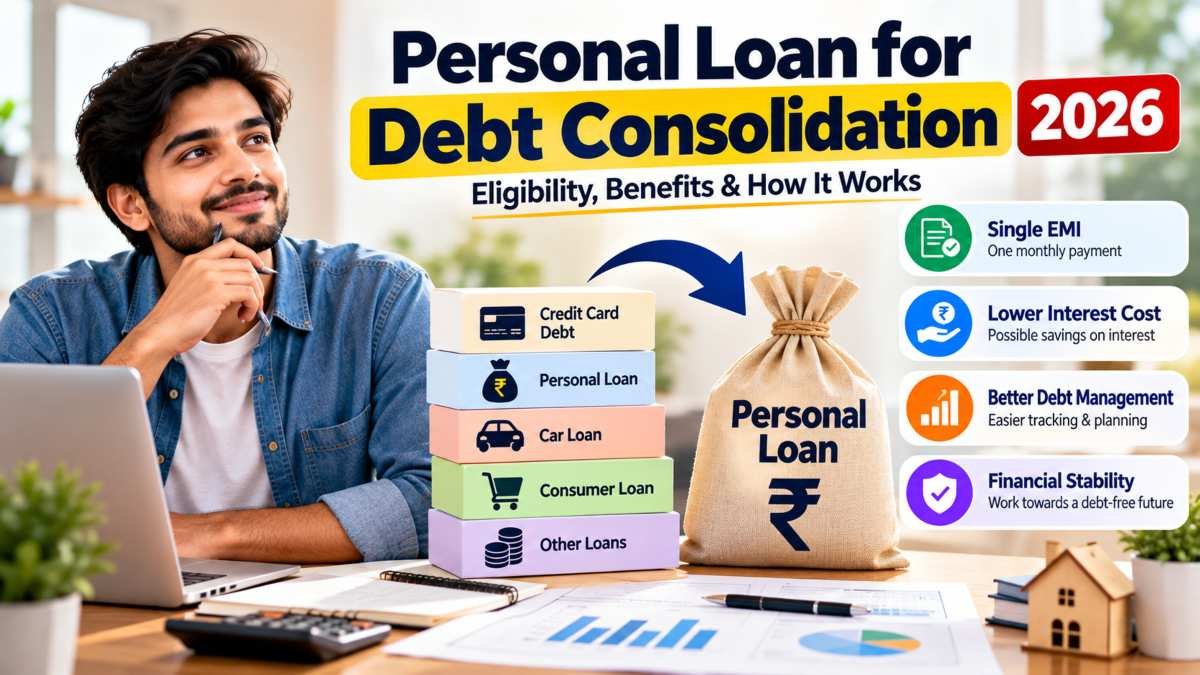
Managing several loans and credit card balances at the same time can become difficult. Different due dates, interest rates and monthly payments can make it harder to keep track of your finances.
A personal loan for debt consolidation is one option that some borrowers consider to combine multiple outstanding debts into a single loan. Instead of making payments to several lenders, the borrower uses a new personal loan to repay eligible existing debts and then makes one regular EMI on the new loan.
However, debt consolidation does not automatically reduce the total amount you owe. The result depends on the new loan’s interest rate, tenure, processing fees, foreclosure or prepayment charges where applicable, and the debts being replaced.
Before applying, borrowers should compare the complete cost of the new loan with their existing repayment obligations.
Read Also: Best Business Banking Accounts 2026: Fees, Features, Requirements & How to Choose the Right Account
What Is a Personal Loan for Debt Consolidation?
A personal loan for debt consolidation is generally an unsecured loan used to repay multiple existing debts.
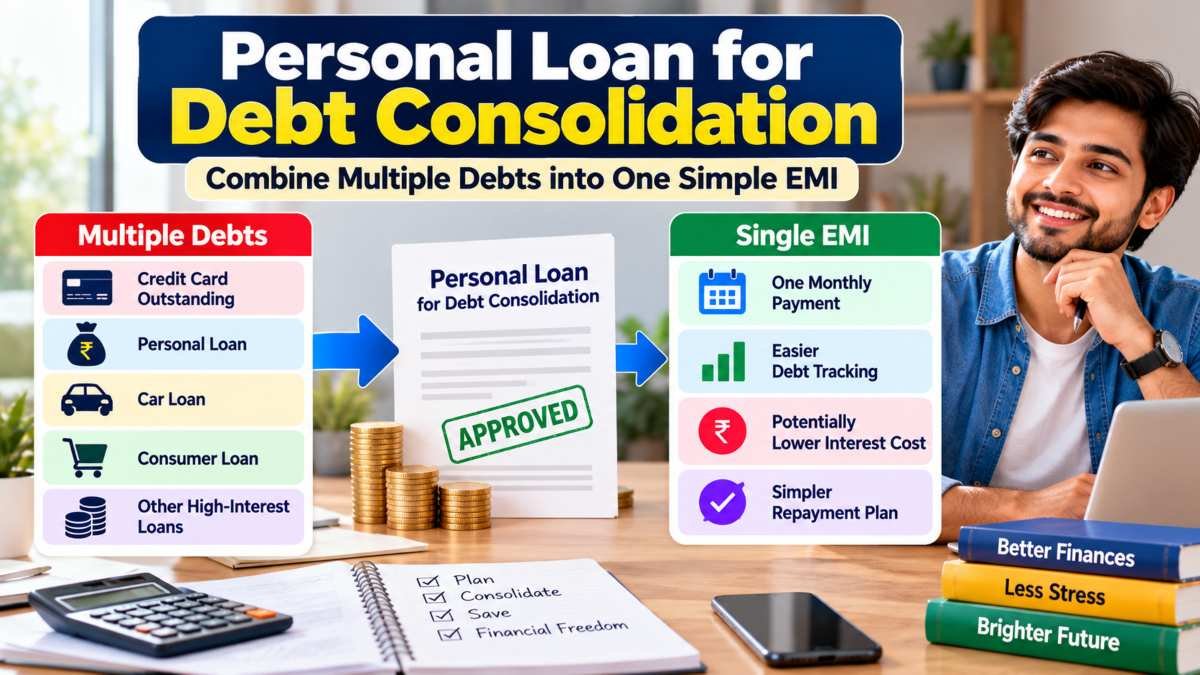
For example, suppose a person has:
- Credit card outstanding
- Existing personal loan
- Consumer loan
- Other eligible high-cost debt
Instead of managing several repayments, the borrower may take a new personal loan large enough to cover some or all of those outstanding balances.
The old debts are then repaid according to the applicable process, while the borrower continues with the new personal loan and its EMI.
The main idea is combining multiple debts into one repayment, not creating additional money for spending.
The exact debts that can be consolidated depend on the lender’s policy and the terms of the new loan.
How Debt Consolidation With a Personal Loan Works
The process is usually straightforward, although the exact procedure differs between lenders.
Step 1: List Your Existing Debts
Start by writing down every outstanding loan or credit balance.
Include:
| Information | What to Check |
|---|---|
| Outstanding balance | Amount still payable |
| Interest rate | Current rate on each debt |
| EMI/minimum payment | Current monthly obligation |
| Remaining tenure | Months or years left |
| Prepayment/closure charges | Check existing loan terms |
| Other fees | Processing or applicable charges |
This gives you a clear picture of how much you currently owe.
Step 2: Calculate the Total Amount
Add the balances that you actually want to consolidate.
Do not automatically borrow more than necessary. A larger personal loan means a larger principal and potentially higher overall interest and fees.
Step 3: Compare Personal Loan Offers
Look beyond the advertised interest rate.
Compare the:
- Interest rate
- Annual Percentage Rate (APR), where provided
- Processing fee
- Other applicable charges
- Loan tenure
- EMI
- Prepayment or foreclosure conditions
- Total amount payable
For digital loans regulated under RBI’s framework, the Key Fact Statement (KFS) is an important document. RBI requires the applicable APR and other prescribed information to be disclosed in the KFS before the loan contract is executed.
Read Also: Wonga Loans Online Application Form 2026 – Eligibility & Application Process
Step 4: Apply With the Lender
After comparing the available options, you can apply with the lender that meets your requirements and eligibility conditions.
The lender may assess factors such as income, existing obligations, credit history and other information required under its credit-assessment process.
Approval is not guaranteed simply because the purpose of the loan is debt consolidation.
Step 5: Use the Loan to Clear Existing Debt
Once the new loan is approved and disbursed, the funds can be used according to the lender’s permitted purpose and process to clear the existing debts.
Keep proof of closure or repayment for every account that has been settled.
This is important because simply receiving a new loan does not mean your old accounts have automatically been closed.
Personal Loan for Debt Consolidation – Eligibility
There is no single eligibility rule for every lender.
Banks and other regulated lenders can have their own credit policies, so the exact requirements may differ.
Common factors considered during a personal-loan application can include:
- Age
- Employment or income
- Monthly income
- Existing financial obligations
- Credit history
- Credit score or other credit information
- Employment stability
- Loan amount requested
- Repayment capacity
- Existing relationship with the lender
Some lenders may also require specific employment, residence or income-document conditions.
Therefore, borrowers should check the current eligibility criteria directly with the lender instead of relying on a fixed income or credit-score number published on an unrelated website.
Documents Required for a Debt Consolidation Personal Loan
The exact document list varies by lender and applicant.
Depending on the lender, borrowers may be asked for documents such as:
- Identity proof
- Address proof
- PAN
- Income proof
- Salary slips
- Bank statements
- Employment details
- Existing loan statements
- Credit-card outstanding statements
- Other documents requested during verification
For debt consolidation, existing loan or credit-card statements can be particularly useful because they show the outstanding balances that the borrower wants to repay.
Do not provide sensitive financial information through unofficial links or unknown agents.
Benefits of a Personal Loan for Debt Consolidation
Debt consolidation can have some practical advantages when the new loan is structured appropriately.
One EMI
Instead of remembering several payment dates, you may have one regular EMI on the consolidation loan.
This can make monthly budgeting easier.
Easier Debt Tracking
Managing one loan account can be simpler than tracking several credit cards and loans.
You can monitor one repayment schedule, one outstanding balance and one lender account.
Potentially Lower Cost
If the new loan has a lower effective cost than the debts being replaced, consolidation may reduce the interest burden.
However, this should be calculated using the total cost of borrowing, not just the advertised interest rate.
A longer tenure can reduce the monthly EMI while increasing the total interest paid over the life of the loan.
Fixed Repayment Schedule
A personal loan generally has a defined repayment schedule.
This can make it easier to plan monthly expenses compared with revolving credit balances where the outstanding amount can continue to change.
Is Debt Consolidation Always a Good Idea?
Not necessarily.
A consolidation loan changes the structure of your debt, but it does not remove the underlying financial obligation.
For example, if someone takes a new loan to clear credit-card debt but continues making large new credit-card purchases, the person can end up with new credit-card debt plus the consolidation loan.
RBI’s lending framework focuses on transparent disclosure and responsible lending, while consumer-finance guidance also emphasizes checking affordability and the total cost before consolidating debt.
Before applying, consider why the debt accumulated in the first place. If monthly spending remains higher than income, simply replacing several debts with one loan may not solve the underlying problem.
Personal Loan vs Existing Debt – What Should You Compare?
Before accepting an offer, prepare a simple comparison.
| Factor | Existing Debts | New Personal Loan |
|---|---|---|
| Number of accounts | Multiple | Usually one |
| Monthly payments | Multiple | One EMI |
| Interest rate | Different rates | New applicable rate |
| Fees | Existing charges | Processing/other applicable charges |
| Tenure | Different | New tenure |
| Total repayment | Calculate | Calculate |
| Prepayment conditions | Varies | Check lender terms |
The important figure is not simply the new EMI.
You should compare the total amount you will pay from today until all the debts are fully cleared.
RBI Rules and Key Fact Statement
Borrowers in India should pay attention to the Key Fact Statement (KFS) when taking a digital loan from a regulated entity.
RBI’s digital-lending framework requires the applicable APR to be disclosed upfront and included in the KFS. The KFS also contains prescribed information about the loan, including charges and other important terms. RBI states that charges not mentioned in the KFS generally cannot be charged during the loan term.
This makes the KFS an important document to read before accepting a digital loan.
Do not focus only on an EMI displayed in an advertisement. Read the complete loan terms and understand what you will actually repay.
Important Things to Check Before Applying
Before choosing a personal loan for debt consolidation, check these five points:
1. Total outstanding debt: Know exactly how much you need to repay.
2. New loan cost: Check interest, APR, processing fee and other applicable charges.
3. New tenure: A longer tenure can reduce the EMI but may increase total interest.
4. Existing loan closure charges: Check whether your current lenders charge any applicable foreclosure or prepayment amount.
5. Repayment capacity: Make sure the new EMI fits comfortably within your monthly budget.
How to Know If Debt Consolidation Will Save Money
A lower EMI does not automatically mean that a debt-consolidation loan is cheaper.
Before accepting a new personal loan, compare the total remaining cost of your existing debts with the total cost of the new loan.
For example, suppose you currently have three debts with different interest rates and repayment periods. A new personal loan may give you one EMI, but if you choose a much longer tenure, the total interest paid could still be significant.
Your comparison should include:
- Remaining principal on existing debts
- Remaining interest
- Existing closure or prepayment charges, if applicable
- New loan principal
- New loan interest
- Processing fee
- Applicable taxes and other charges
- New loan tenure
- Total repayment amount
The objective should be to understand the complete financial cost, not simply reduce the monthly payment.
Debt Consolidation Loan Calculator – What to Calculate
You can make a simple calculation before applying.
Existing Debt Cost
Add the remaining payments on the debts you want to consolidate and account for any applicable closure charges.
New Loan Cost
Calculate the total amount payable under the proposed personal loan, including applicable charges.
Then compare the two figures.
For example:
| Particular | Existing Debts | Consolidation Loan |
|---|---|---|
| Outstanding principal | ₹3,00,000 | ₹3,00,000 |
| Number of accounts | 3 | 1 |
| Monthly payments | Multiple | One EMI |
| Interest | Different | New applicable rate |
| Fees | Existing applicable charges | New applicable charges |
| Tenure | Different | New selected tenure |
| Total cost | Calculate | Calculate |
These numbers are only an illustration. Your actual cost will depend on your individual loans and the offer provided by the lender.
Does Debt Consolidation Affect Your Credit Score?
Applying for a new personal loan can affect your credit profile because lenders generally assess your credit information when evaluating an application.
A new loan also creates a new credit account.
However, there is no universal rule that taking a consolidation loan will automatically improve or damage your credit score.
Your future repayment behavior is important.
If you use the new loan to clear existing debts and then make all repayments on time, your credit history can reflect that repayment behavior. On the other hand, taking additional credit, missing EMIs or allowing old accounts to remain unpaid can create further financial problems.
Therefore, do not choose debt consolidation solely because you expect a particular credit-score increase.
Personal Loan vs Credit Card Balance Transfer
A personal loan is not the only way to manage multiple debts.
Some borrowers may also consider a credit-card balance transfer, depending on the offers available to them.
The two options work differently.
| Feature | Personal Loan | Credit Card Balance Transfer |
|---|---|---|
| Main purpose | Can consolidate eligible debts | Usually moves eligible card debt |
| Repayment | Fixed EMI | Depends on the applicable offer |
| Tenure | Selected loan tenure | Offer-specific |
| Interest/cost | Depends on lender | Depends on card issuer and offer |
| Eligible debt | Depends on lender | Generally card-related |
| Fees | Check loan agreement | Check balance-transfer terms |
A balance-transfer offer that looks inexpensive initially can still have fees, conditions or a limited promotional period.
Read the complete terms before choosing either option.
Personal Loan for Credit Card Debt
Credit-card balances can become expensive if only minimum payments are made for a prolonged period.
A personal loan may be considered for paying off eligible credit-card balances when the overall cost and repayment structure make financial sense.
However, borrowers should avoid closing the credit-card balance with a personal loan and then immediately rebuilding the same balance through new spending.
That can result in two obligations:
New personal-loan EMI + new credit-card balance.
If the original spending pattern continues, consolidation may only postpone the underlying problem.
Common Mistakes to Avoid
Choosing a Loan Only Because of a Low EMI
A low EMI can result from a longer repayment period.
Always check the total repayment amount and applicable charges.
Ignoring Processing Fees
A loan advertised at an attractive interest rate may still involve processing or other applicable charges.
Read the KFS and loan agreement carefully.
Borrowing More Than Required
If your existing eligible debt is ₹3 lakh, borrowing ₹5 lakh simply because a lender offers the larger amount can increase your repayment burden.
Borrow according to your actual requirement and affordability.
Not Closing Old Debt Properly
After using a consolidation loan to repay existing liabilities, confirm that the relevant old accounts have been settled according to their terms.
Keep closure letters, statements or other supporting records where applicable.
Taking Multiple New Loans
Applying for several loans at the same time can create additional financial obligations and multiple credit enquiries.
Compare options first and apply selectively.
Continuing the Same Spending Pattern
Debt consolidation does not fix overspending by itself.
If spending remains higher than income, another loan may create additional pressure later.
Alternatives to a Debt Consolidation Personal Loan
Depending on your situation, you may have other options.
Negotiate Existing Debt
Contact your existing lender and ask whether any repayment restructuring or other applicable option is available.
The answer will depend on the lender’s policy and your account status.
Use Existing Savings Carefully
If you have sufficient emergency savings, you may consider whether using a portion of those savings to reduce expensive debt makes sense.
However, avoid using all emergency funds and leaving yourself without a financial buffer.
Reduce Discretionary Spending
Review subscriptions, non-essential purchases, dining, shopping and other discretionary expenses.
Even a temporary reduction can free up money for debt repayment.
Seek Professional Financial Advice
If your debt situation is complicated or you are struggling to make repayments, consider speaking with a qualified financial professional or an appropriate credit-counselling service.
Is a Personal Loan for Debt Consolidation Right for You?
There is no single answer for every borrower.
Debt consolidation may be worth considering when it genuinely makes repayment easier and the new borrowing cost is reasonable compared with the debts being replaced.
It requires more caution when:
- You are borrowing to cover regular monthly expenses.
- Your income is insufficient for existing obligations.
- The new loan only reduces EMI by extending the tenure significantly.
- You have already missed several repayments.
- You are planning to continue using credit cards heavily after consolidation.
- The new loan’s total cost is not clearly understood.
The key question is not simply “Can I get another loan?”
It is:
“Will this new loan make my overall debt easier and financially more manageable to repay?”
Digital Lending Safety Tips
If you apply for a personal loan online, verify the lender and the terms before submitting financial information.
RBI’s digital-lending framework requires regulated entities to provide borrowers with important information and disclosures, including the applicable Key Fact Statement. RBI also requires specific safeguards around digital lending practices and borrower data.
Keep these basic precautions in mind:
- Use the lender’s official website or application.
- Verify the name of the regulated lender.
- Read the KFS before accepting the loan.
- Check the APR and applicable charges.
- Never share your banking password or OTP with an unknown person.
- Do not pay an unknown agent simply because they promise guaranteed approval.
- Check the loan agreement before accepting.
- Keep copies of important documents and repayment records.
Personal Loan for Debt Consolidation – Final Checklist
Before accepting a consolidation loan, go through this checklist:
☐ I know the exact amount of debt I want to consolidate.
☐ I have checked the remaining cost of my existing debts.
☐ I have checked the new loan’s interest rate and APR.
☐ I have read the KFS.
☐ I understand the processing fee and other applicable charges.
☐ I have checked the new loan tenure.
☐ I know the total amount payable.
☐ I have checked existing debt closure/prepayment conditions.
☐ The new EMI fits my monthly budget.
☐ I have a plan to avoid rebuilding unnecessary debt.
☐ I am using an official lender channel.
Personal Loan for Debt Consolidation 2026 – FAQs
Can I use a personal loan to consolidate multiple debts?
A personal loan may be used to repay multiple existing debts where the lender permits this purpose. The exact eligible debts and loan conditions depend on the lender.
Does debt consolidation reduce the total debt?
Not automatically. The new loan replaces existing liabilities with a new liability. The total cost depends on the principal, interest, tenure and applicable fees.
Is a lower EMI always better?
No. A lower EMI may result from a longer tenure, which can increase the total interest paid. Compare the complete repayment cost before deciding.
Can I consolidate credit-card debt with a personal loan?
Some borrowers use personal loans to repay credit-card balances, subject to the lender’s terms and eligibility. Compare the complete cost before transferring the debt.
Will debt consolidation improve my credit score?
There is no guaranteed result. Your credit profile depends on various factors, including repayment history and outstanding credit. Taking a consolidation loan should not be viewed as a guaranteed way to increase your score.
What is a KFS for a personal loan?
A Key Fact Statement (KFS) is a standardized disclosure document containing important information about the loan, including the applicable APR and prescribed charges and terms. RBI’s framework requires applicable digital loans from regulated entities to provide the KFS before execution of the loan contract.
Should I take a personal loan just to reduce my EMI?
Not necessarily. A lower EMI can be useful for cash-flow management, but you should first check whether the new loan actually makes the overall debt cost and repayment plan more manageable.
Final Words
A personal loan for debt consolidation can simplify several repayments into one EMI, but it is not automatically a cheaper solution.
Before applying, calculate your existing debt, compare the complete cost of the new loan, read the KFS and check whether the proposed EMI fits comfortably into your budget.
Most importantly, use consolidation as part of a repayment plan rather than treating it as additional spending capacity.
The right choice depends on your individual debts, income, loan terms and repayment ability. Compare the numbers carefully before taking on a new financial obligation.
