
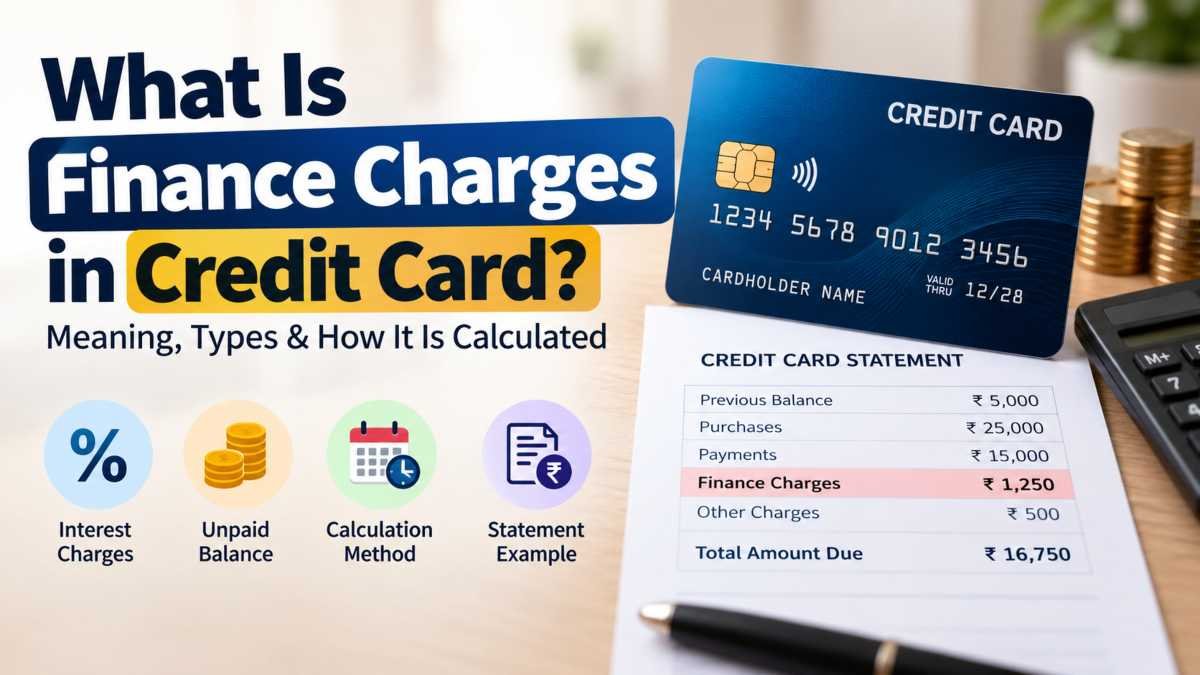
If you use a credit card, you may have noticed a “Finance Charges” entry on your monthly credit card statement. For many cardholders, this charge can be confusing because it is not the same as the annual fee, late payment fee or GST.
In simple words, finance charges in a credit card are generally the interest-related charges applied when you carry an unpaid balance or use certain credit facilities such as cash advances. The exact rate and calculation method depend on the credit card issuer and the terms of your card.
This guide explains what finance charges mean, when they are charged, how they can affect your bill and what you can do to avoid unnecessary interest costs.
Quick Bio
| Particular | Details |
|---|---|
| Topic | Finance Charges on Credit Cards |
| Primary Keyword | What is finance charges in credit card |
| Main Intent | Informational |
| Category | Personal Finance / Credit Cards |
| Applies To | Credit Card Users |
| Key Topics | Meaning, interest, calculation, unpaid balance, cash advances |
| Important Authority | Reserve Bank of India (RBI) |
| Best For | Understanding credit card statements and charges |
What Are Finance Charges in a Credit Card?
Finance charges are charges related to the cost of using credit when the applicable interest-free conditions are not met.
For example, suppose you spend ₹30,000 using your credit card during a billing cycle. If your card allows an interest-free period and you pay the applicable total amount due within the due date, you may avoid interest on regular purchases.
However, if you carry an unpaid balance, the card issuer may charge interest according to the rate and terms applicable to your card.
The important point is that finance charges are not necessarily a fixed amount for every credit card. Different banks and card issuers can have different interest rates, billing rules and applicable charges.
RBI requires credit card issuers to disclose finance charges for revolving credit and cash advances as part of the important terms and conditions provided to customers.
Read Also: Umwalimu SACCO Loan Application Form 2026 – Requirements, Online Application & How to Apply
Why Do Credit Cards Charge Finance Charges?
A credit card gives you access to a line of credit. When you do not pay the applicable amount within the required period, the issuer may charge interest for the outstanding amount.
This is one reason why paying only the Minimum Amount Due can become expensive.
RBI requires card issuers to prominently warn customers that making only the minimum payment every month can stretch repayment over months or years and result in compounded interest on the outstanding balance.
So, while paying the minimum amount may help you avoid certain immediate consequences associated with missing the minimum payment, it does not mean that the remaining balance becomes interest-free.
When Are Finance Charges Applied?
Finance charges can commonly arise in situations such as:
1. Carrying an Unpaid Credit Card Balance
If you do not clear the applicable outstanding amount by the due date, interest may be charged according to your card’s terms.
The exact calculation can vary between issuers, so you should always check the interest rate and finance-charge section of your card’s MITC and statement.
2. Credit Card Cash Withdrawal
Using a credit card to withdraw cash is different from making a normal purchase.
Cash advances can have separate fees and interest terms. RBI specifically requires card issuers to disclose cash advance fees and finance charges for cash advances in the card’s important terms and conditions.
For this reason, cash withdrawal through a credit card can become costly if the amount is not repaid quickly.
3. Outstanding Balance From the Previous Bill
If an amount from a previous statement remains unpaid, the interest-free period can be affected.
RBI’s directions require card issuers to explain that the interest-free credit period is suspended if there is an outstanding balance from the previous month.
This is an important point that many new credit card users overlook.
Read Also: PIP Application Form 2026 – Eligibility, How to Apply, Documents & Claim Process
Is Finance Charge the Same as a Late Payment Fee?
No. Finance charges and late payment fees are different.
A finance charge generally relates to the cost of carrying credit or applicable interest charges.
A late payment fee is a separate charge associated with not making the required payment by the due date, subject to the card issuer’s terms and applicable RBI rules.
Your statement may contain several different components, such as:
- Interest or finance charges
- Late payment charges
- Annual or membership fees
- Cash advance fees
- Other transaction or service charges
- Applicable taxes
Therefore, if you see a finance charge on your statement, don’t automatically assume it is a late payment fee.
How Are Credit Card Finance Charges Calculated?
The exact calculation depends on the card issuer’s terms, including the applicable interest rate, outstanding amount and transaction/payment dates.
A simplified illustration can help.
Suppose:
- Outstanding amount = ₹20,000
- Monthly interest rate = 3%
- Applicable finance charge period = 1 month
A simple illustration would be:
₹20,000 × 3% = ₹600
So, the interest component could be around ₹600 for that assumed period.
However, this is only an example and should not be treated as the actual calculation for every credit card. Credit card issuers may calculate interest based on daily outstanding balances and the applicable transaction, billing and payment dates.
RBI’s 2024 amendment also states that interest shall be levied only on the outstanding amount, after adjusting for payments, refunds and reversed transactions.
Therefore, for an exact calculation, always check your card issuer’s latest MITC, statement and applicable interest-rate terms.
How Can You Avoid Credit Card Finance Charges?
The simplest way to reduce avoidable finance charges is to use your credit card within a repayment amount that you can comfortably clear.
Here are some practical steps:
- Pay the applicable Total Amount Due by the due date.
- Avoid carrying a balance from one billing cycle to another.
- Use credit card cash withdrawals only when genuinely necessary.
- Check your monthly statement carefully.
- Understand your card’s interest rate before using revolving credit.
- Do not assume that paying only the minimum amount will keep the remaining balance interest-free.
- Check the issuer’s MITC for current fees and charges.
The exact terms differ between cards, so the statement and card agreement should always be treated as the final reference for your account.
Bottom Line
Finance charges in a credit card are generally the interest-related cost of carrying outstanding credit or using certain credit facilities such as cash advances. They are different from fees such as annual charges or late payment charges.
If you understand your card’s billing cycle, interest rate and payment due date, you can avoid many unnecessary credit costs. Most importantly, don’t look only at the Minimum Amount Due—understand how much you need to pay to maintain the applicable interest-free benefit.
How Is Finance Charge Calculated on a Credit Card?
Credit card finance charges are not always calculated simply by applying a monthly interest rate to the final bill amount.
Depending on the card’s terms, the issuer may calculate interest using the outstanding balance and the number of days for which the amount remains unpaid.
A simplified formula can be shown as:
Finance Charge = Outstanding Amount × Applicable Interest Rate × Number of Days ÷ 365
However, this is only a general illustration. The actual method used by a particular credit card issuer can differ.
For example, assume:
- Outstanding amount: ₹20,000
- Annual interest rate: 36%
- Outstanding for: 30 days
The simplified calculation would be:
₹20,000 × 36% × 30 ÷ 365 = approximately ₹592
This example is only for understanding the calculation. Your actual finance charge can be different because the issuer may consider individual transaction dates, payments, refunds, reversals and other applicable terms.
Why Transaction Dates Can Matter
Credit card interest calculations can become confusing because purchases made during a billing cycle may not all have the same transaction date.
For example, imagine you make these purchases:
| Transaction | Amount | Date |
|---|---|---|
| Grocery | ₹5,000 | April 2 |
| Shopping | ₹8,000 | April 10 |
| Fuel | ₹3,000 | April 20 |
| Total | ₹16,000 | — |
If an amount remains unpaid, the applicable calculation may depend on the issuer’s billing and interest calculation method.
This is why simply taking the final statement balance and multiplying it by the monthly interest rate may not always reproduce the exact finance charge shown on your statement.
What Happens If You Pay Only the Minimum Amount?
This is one of the most important things every credit card user should understand.
Your credit card statement generally shows a Minimum Amount Due along with the total amount payable.
Paying the minimum amount may keep the account from being treated as an unpaid minimum payment, but it does not mean the remaining balance becomes free credit.
The unpaid amount can continue to attract applicable interest according to the card’s terms.
RBI specifically requires card issuers to warn customers about the consequences of making only the minimum payment, including the possibility that repayment can extend for a long period and interest can compound on the outstanding balance.
Therefore, if financially possible, paying the Total Amount Due by the due date is generally the better way to avoid revolving credit interest.
Example: Minimum Payment vs Full Payment
Suppose your credit card statement shows:
- Total Amount Due: ₹25,000
- Minimum Amount Due: ₹1,250
If you pay ₹25,000 within the applicable due date, you may avoid interest on eligible purchases subject to the card’s terms.
But if you pay only ₹1,250, the remaining balance does not simply disappear.
The unpaid balance can continue to attract applicable interest and may make your next statement substantially higher.
This is why credit cards should ideally be used for purchases that you can afford to repay.
What Is the Interest-Free Period?
The interest-free period is the period during which eligible credit card purchases may not attract interest when the applicable payment conditions are met.
The length of this period can vary depending on the card’s billing cycle and transaction date.
For example, a purchase made soon after the previous statement date may receive a longer interest-free period than a purchase made shortly before the next statement is generated.
However, the interest-free benefit is generally conditional.
If you have an outstanding balance from the previous billing cycle, the interest-free period can be affected according to the card’s terms.
RBI requires issuers to clearly disclose the interest-free credit period and the conditions under which it is available.
Finance Charges on Cash Withdrawal
Credit card cash withdrawals should be treated differently from normal purchases.
When you withdraw cash using a credit card, the issuer may apply:
- Cash advance fee
- Applicable finance/interest charges
- Taxes on applicable charges
The exact amount depends on the credit card issuer and the specific card.
Cash withdrawals can therefore become expensive, particularly when the amount remains unpaid for an extended period.
Before withdrawing cash from a credit card, check the card’s latest fee and interest information.
Finance Charges vs Annual Fee vs Late Payment Fee
These charges are often confused, but they are not the same.
| Charge | Meaning |
|---|---|
| Finance Charge | Generally interest-related cost on applicable outstanding credit |
| Annual Fee | Fee charged for maintaining/using certain credit cards |
| Late Payment Fee | Charge that may apply when the required payment is not made by the due date |
| Cash Advance Fee | Fee associated with eligible cash withdrawals |
| GST/Taxes | Applicable taxes on taxable charges/services |
The exact amount and applicability depend on the card issuer and the terms of your card.
Where Can You Find Finance Charges on Your Credit Card Statement?
If finance charges have been applied, they may appear as a separate entry in your credit card statement.
Depending on the issuer, you may see descriptions such as:
- Finance Charges
- Interest Charges
- Interest on Revolving Credit
- Interest on Cash Withdrawal
- Finance Charges on Retail Purchases
The exact wording can differ between banks and card issuers.
When checking your statement, look at:
- Previous balance
- New purchases
- Payments received
- Refunds or reversals
- Finance/interest charges
- Fees
- Taxes
- Total Amount Due
- Minimum Amount Due
- Payment due date
This makes it easier to understand why your outstanding balance has increased or decreased.
Can Finance Charges Be Refunded?
A finance charge is not automatically refundable.
If you believe a charge has been incorrectly applied, you should first check your statement, transaction history and the card’s applicable terms.
If there is an error, contact the card issuer through its official customer-service channel and raise a dispute.
Keep your statement and relevant transaction details available while making the complaint.
If the issue is not resolved through the issuer’s grievance process, customers can use the applicable RBI complaint mechanism, subject to the eligibility and procedure applicable at that time.
How to Reduce Finance Charges
You can take several practical steps to reduce the possibility of paying unnecessary credit-card interest.
Pay on Time
Always keep the payment due date in mind. Setting up reminders or eligible automatic payments can help prevent missed payments.
Pay the Total Amount Due
If you can afford it, paying the total amount due is generally preferable to repeatedly carrying a balance.
Avoid Unnecessary Cash Withdrawals
Credit card cash withdrawals can involve separate charges and interest, so they should generally be used only when necessary.
Understand Your Interest Rate
Before using revolving credit, check your card’s applicable monthly and annualised interest rate.
Check Your Statement Every Month
A quick statement review can help you identify unexpected charges, incorrect transactions or fees.
What Should You Check Before Choosing a Credit Card?
Finance charges are only one part of the cost of a credit card.
Before applying for a card, compare:
- Annual or joining fee
- Interest/finance charge rate
- Cash withdrawal charges
- Late payment charges
- Foreign currency transaction charges
- Reward conditions
- Eligibility requirements
- Interest-free period
- Other applicable fees
A card with attractive rewards is not necessarily the cheapest option if you regularly carry an unpaid balance.
Final Takeaway
Credit card finance charges are mainly associated with the cost of carrying outstanding credit or using certain credit facilities. The exact amount depends on the card issuer’s applicable interest rate, calculation method, outstanding balance and relevant transaction/payment details.
The safest approach is simple: understand your card terms, keep track of the billing and payment dates, and pay the total amount due whenever you can comfortably afford to do so.
Remember that the examples in this article are for explanation only. The actual finance charge on your card should always be checked against your issuer’s latest statement and terms.
Frequently Asked Questions
1. What is finance charges in credit card?
Finance charges are generally interest-related charges applied to eligible outstanding credit or certain credit facilities, depending on the card’s terms.
2. Is finance charge the same as late payment fee?
No. Finance/interest charges and late payment fees are separate types of charges.
3. Can I avoid credit card finance charges?
In many cases, eligible purchase-related interest can be avoided by paying the applicable total amount due within the required time, subject to your card’s terms.
4. Does paying the minimum amount avoid finance charges?
Not necessarily. Paying only the minimum amount generally leaves a balance that may continue to attract applicable interest.
5. Are finance charges applicable to cash withdrawals?
Credit card cash withdrawals can have separate cash advance fees and applicable finance/interest charges.
6. Why is my finance charge different from my calculation?
The issuer may use a specific calculation method involving transaction dates, daily outstanding balances, payments, refunds and other applicable terms.
Disclaimer: This article is for general educational and informational purposes only and should not be considered financial advice. Credit-card rates, fees, calculation methods and policies can change. Always check the latest terms and conditions, MITC and statement issued by your credit-card provider before making financial decisions.
