
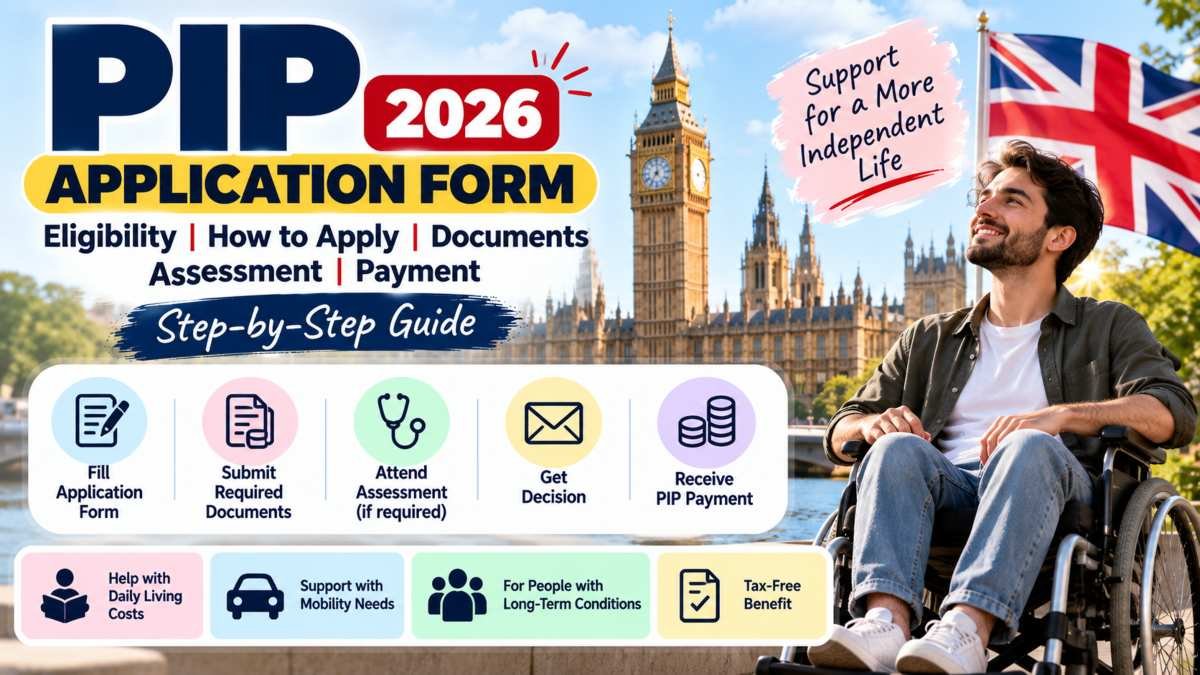
The PIP Application Form 2026 is used to apply for Personal Independence Payment (PIP), a tax-free benefit designed to help with some of the extra costs of living with a long-term physical or mental health condition or disability.
PIP is based on how a condition affects a person’s daily life and mobility, rather than simply the name of the medical condition. The benefit has two parts: Daily Living and Mobility, and a person can qualify for either one or both depending on their circumstances.
The application process can involve an initial claim, a questionnaire about how the condition affects you, supporting evidence and, where necessary, an assessment by a health professional.
PIP Application Form 2026 – Quick Overview
| Particular | Details |
|---|---|
| Benefit Name | Personal Independence Payment |
| Short Name | PIP |
| Country | United Kingdom |
| Main Department | Department for Work and Pensions (DWP) |
| Age | Usually 16 or over and under State Pension age for a new claim |
| Covers | Daily Living and Mobility needs |
| Benefit Type | Tax-free |
| Income/Savings Test | No |
| Payment Frequency | Usually every 4 weeks |
| Application | Online in some areas, or by phone |
| Assessment | May be required |
| Scotland | Adult Disability Payment (ADP) instead |
| Northern Ireland | Separate PIP process |
PIP is generally available to people aged 16 or over who have not reached State Pension age and have a long-term physical or mental health condition or disability that affects certain everyday activities or getting around.
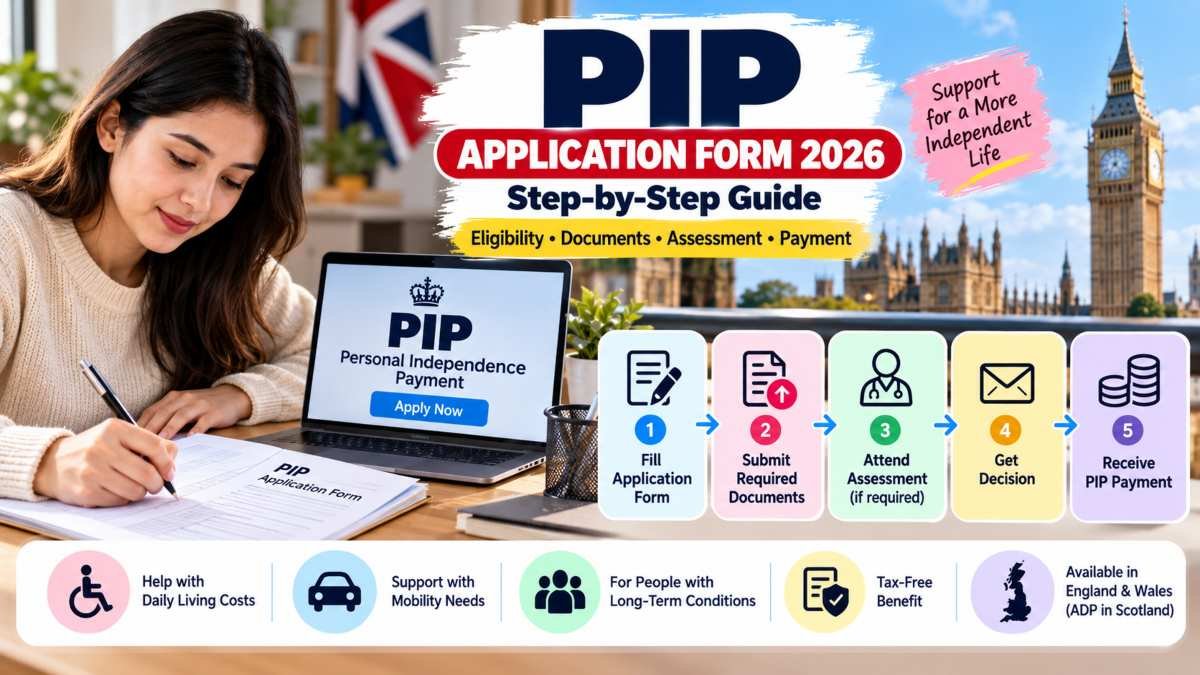
What Is PIP?
Personal Independence Payment is a benefit for people who have difficulties with daily living activities, mobility, or both because of a long-term health condition or disability.
It is not dependent on whether someone is working and it is not means-tested based on income or savings. A person can receive PIP while working if they meet the relevant eligibility requirements.
The award is divided into two components:
- Daily Living component
- Mobility component
Each component has a standard rate and an enhanced rate. A person can receive one component, both components or neither, depending on the assessment of their needs.
PIP Rates 2026/27
The official benefit and pension rates for 2026/27 set the following weekly PIP amounts:
| PIP Component | Standard Rate | Enhanced Rate |
|---|---|---|
| Daily Living | £76.70 per week | £114.60 per week |
| Mobility | £30.30 per week | £80.00 per week |
PIP is tax-free and is normally paid every four weeks. The amount awarded depends on the qualifying difficulties a person has with daily living and mobility activities.
The actual amount someone receives therefore depends on which components they qualify for and at which rate.
PIP Application Form 2026 Eligibility
Before starting a PIP claim, it is important to check the basic eligibility rules.
Generally, you can qualify for PIP if:
- You are 16 or over.
- You have a long-term physical or mental health condition or disability.
- Your condition makes certain everyday activities or getting around difficult.
- You expect those difficulties to last for at least 12 months from when they started.
- You normally need to be under State Pension age when making a new claim.
There are separate rules for people who are nearing the end of life.
Does PIP depend on your income?
No. PIP is not a means-tested benefit. Your income and savings do not normally determine whether you can receive PIP.
You can also receive PIP while working, provided you satisfy the eligibility requirements.
PIP Eligibility for Long-Term Conditions
One important point is that there is no simple list of medical conditions that automatically qualifies someone for PIP.
Instead, the assessment looks at how the condition affects the person’s ability to carry out relevant activities.
For example, a person’s condition may affect their ability to:
- Prepare food
- Eat or drink
- Manage medication or treatment
- Wash and bathe
- Dress and undress
- Communicate
- Read information
- Make budgeting decisions
- Plan or follow a journey
- Move around
The effect of the condition on these activities is more important than simply stating a diagnosis.
PIP Application Form 2026 – How to Apply
The exact claim route depends on where you live and your circumstances.
For many claims in England and Wales, you can start a PIP claim by telephone. You will be asked basic questions about yourself and your disability or condition.
You will then normally receive a form called “How your disability affects you”. This can be completed online or by post, depending on the application route available to you.
In some areas, a full PIP application can also be started online. GOV.UK provides a postcode check to determine whether the online service is available for you.
Basic PIP Application Process
The process generally follows these stages:
1. Start your PIP claim: Begin the claim using the application method available for your location.
2. Provide basic information: You may need to provide personal details, contact information and information about your condition.
3. Complete the health questionnaire: You will receive the form asking how your disability or health condition affects your daily life and mobility.
4. Provide supporting evidence: You can include relevant supporting documents, such as prescription information, care plans or information from healthcare professionals.
5. Attend an assessment if required: Not everyone needs an assessment. If more information is required, an assessment may take place in person, at home, by telephone or by video call.
6. Receive the decision: The DWP will send a decision letter explaining whether PIP has been awarded and, where applicable, the payment and review information.
PIP Application Form 2026 – Documents and Evidence
Supporting evidence can help explain how a condition affects your everyday life.
Depending on your circumstances, useful evidence may include:
- Prescription lists
- Care plans
- Medical information
- Reports from healthcare professionals
- Information from people involved in your care
- Other documents that explain the difficulties you experience
You do not need to rely only on a diagnosis. When completing the form, it is important to explain what difficulties you actually experience, how often they occur and what help or support you need.
GOV.UK specifically advises applicants to include supporting documents if they have them.
Read Also: Blue Badge Application Form 2026-27 Eligibility, Documents, Cost & How to Apply
PIP Application Form 2026 – Important Point About Scotland
PIP rules are not the same across every part of the UK.
If you live in Scotland, you generally need to apply for Adult Disability Payment (ADP) instead of making a new PIP claim.
Northern Ireland also has a separate PIP claiming process. Therefore, applicants should always use the GOV.UK or relevant devolved-government guidance for their location.
| Detail | Information |
|---|---|
| Benefit | Personal Independence Payment |
| Abbreviation | PIP |
| Administered By | Department for Work and Pensions |
| Main Purpose | Help with extra costs related to disability or long-term health conditions |
| Components | Daily Living & Mobility |
| 2026/27 Daily Living | £76.70 / £114.60 weekly |
| 2026/27 Mobility | £30.30 / £80.00 weekly |
| Application | Online in some areas or by phone |
| Assessment | Only when required |
| Scotland | Adult Disability Payment |
| Payment | Usually every 4 weeks |
Questions You May Need to Answer
The PIP “How your disability affects you” form asks about the difficulties you have with everyday activities and mobility.
The purpose is not simply to provide the name of your medical condition. You need to explain how your condition or disability affects you personally and what help, support or adaptations you need.
The form covers areas related to daily living and mobility, including activities such as:
- Preparing food
- Eating and drinking
- Managing medication or treatment
- Washing and bathing
- Managing toilet needs
- Dressing and undressing
- Communicating
- Reading and understanding information
- Mixing with other people
- Making budgeting decisions
- Planning or following journeys
- Moving around
The form also provides space for additional information so you can explain difficulties that may not be obvious from a simple yes-or-no answer.
How to Answer the PIP Application Form
When answering the questions, focus on what actually happens in your everyday life.
For example, instead of simply writing that you have a particular medical condition, explain:
- What activity is difficult
- What happens when you try to do it
- How often the difficulty occurs
- Whether you need help from another person
- Whether you use an aid or appliance
- How long the activity takes
- Whether you can complete it safely
- Whether your ability changes from day to day
This gives the decision maker information about the practical effect of your condition.
If your condition fluctuates, explain the variation rather than describing only one unusually good or bad day.
PIP Supporting Evidence 2026
Supporting evidence can help DWP understand your individual circumstances.
Examples can include:
- Prescription lists
- Care plans
- Reports from doctors
- Reports from nurses
- Occupational therapy reports
- Physiotherapy information
- Hospital letters
- Reports from social workers
- Information from other professionals involved in your care
- Relevant statements from people who understand how your condition affects you
The official PIP form guidance says applicants should provide documents they already have that help explain their needs. It also says applicants should not delay returning the form simply because they are waiting for additional evidence.
Importantly, evidence should help explain how your condition affects you personally. General information about a medical condition is less useful than evidence describing your own difficulties.
Read Also: Personal Loan for Debt Consolidation 2026 – Eligibility, Benefits & How It Works
How Long Do You Have to Return the PIP Form?
After starting a PIP claim, you will normally receive the “How your disability affects you” form.
GOV.UK says you usually need to complete the form online or return it by post within 1 month. If you need more time, contact the PIP enquiry line and explain your circumstances.
If you are waiting for supporting evidence, send the completed form on time with the evidence you already have. Additional evidence can be sent later where appropriate.
PIP Assessment 2026
Not everyone who applies for PIP will need an assessment.
DWP may arrange an assessment if more information is required to make a decision about the claim. The assessment is carried out by a health professional.
Depending on the circumstances, an assessment can take place:
- At an assessment centre
- At your home
- By telephone
- By video call
GOV.UK says an assessment usually takes around 1 hour, although the actual circumstances can vary. You can also have another person with you, such as a friend or support worker.
During the assessment, the health professional may ask about how your condition affects daily living and mobility and about treatments you have had or may have.
What Happens After the PIP Assessment?
After the required evidence has been gathered, including an assessment where one is needed, DWP considers the information before making a decision.
You will receive a decision letter.
If PIP is awarded, the letter will explain:
- Whether you receive the Daily Living component
- Whether you receive the Mobility component
- The rate awarded
- Your first payment date
- How long the award is expected to last
- When your claim will be reviewed
According to current GOV.UK guidance, an initial PIP award can range from 9 months to 10 years, depending on whether your needs are expected to change.
PIP Payment 2026/27
For the 2026/27 benefit year, the weekly PIP rates are:
| Component | Standard Rate | Enhanced Rate |
|---|---|---|
| Daily Living | £76.70 | £114.60 |
| Mobility | £30.30 | £80.00 |
The amount you receive depends on which component or components you qualify for and the rate awarded.
PIP is normally paid every four weeks.
Can You Challenge a PIP Decision?
Yes. If you disagree with a PIP decision, you can ask DWP for a Mandatory Reconsideration (MR).
This is the process used to ask DWP to review the decision again.
You should explain why you believe the decision is incorrect and provide any relevant information or evidence that supports your position.
A Mandatory Reconsideration normally needs to happen before you can appeal to an independent tribunal.
If you remain dissatisfied after the Mandatory Reconsideration, you may be able to appeal to the tribunal administered by HM Courts & Tribunals Service.
PIP Application 2026 – England, Scotland and Northern Ireland
The PIP process is not identical throughout the UK.
England and Wales
New PIP claims are generally made through the PIP process administered by DWP.
Scotland
If you live in Scotland, you normally need to apply for Adult Disability Payment (ADP) instead of making a new PIP claim.
Northern Ireland
Northern Ireland has its own PIP application process through the Department for Communities.
Therefore, always check the official guidance for the part of the UK where you live before starting a claim.
PIP Application Form 2026 – Common Mistakes to Avoid
When completing a PIP application, avoid these common problems:
Giving only the diagnosis: A diagnosis alone does not explain how your everyday activities are affected.
Providing very short answers: Use the available space to explain your actual difficulties.
Ignoring fluctuating symptoms: If your ability changes, explain how often the changes occur and what impact they have.
Forgetting help from other people: Mention assistance you regularly need from family members, carers or other people.
Leaving out supporting evidence: Provide relevant evidence you already have where it helps explain your needs.
Missing the deadline: Return the form within the required period or contact the PIP enquiry line if you need more time.
PIP Application Form 2026 FAQs
Is PIP based on income?
No. PIP is not a means-tested benefit. Eligibility is based on the relevant disability and daily-living or mobility criteria rather than your income or savings.
Do I need a medical diagnosis to claim PIP?
A diagnosis itself does not determine the award. The assessment considers how your condition or disability affects your ability to carry out relevant activities.
Does everyone have to attend a PIP assessment?
No. An assessment may be arranged when DWP needs more information. In some cases, the available evidence may be sufficient without a consultation.
Can I work and receive PIP?
Yes. PIP is not a benefit that automatically stops because you work. The relevant eligibility criteria still need to be satisfied.
Can someone help me complete the PIP form?
Yes. If you need help, you can ask someone you trust to assist you. You can also contact the relevant PIP service if you need support with the application process.
How long does a PIP award last?
There is no single fixed award period for everyone. GOV.UK says an award can be between 9 months and 10 years depending on whether the person’s needs are expected to change.
Can I send additional evidence after submitting my form?
Yes, where relevant. The official form guidance explains that if you are waiting for evidence, you should still return your completed form on time and can send further supporting evidence afterwards.
Final Words
The PIP Application Form 2026 is an important part of the Personal Independence Payment claim process. The key thing to remember is that the application is about the real impact of your condition or disability on your daily living and mobility, not simply the name of your diagnosis.
Take time to describe your difficulties accurately, provide relevant evidence that you already have, and follow the deadline given with your form.
Because PIP rules and procedures can change, applicants should always check the latest information on GOV.UK before starting a claim or challenging a decision.
