
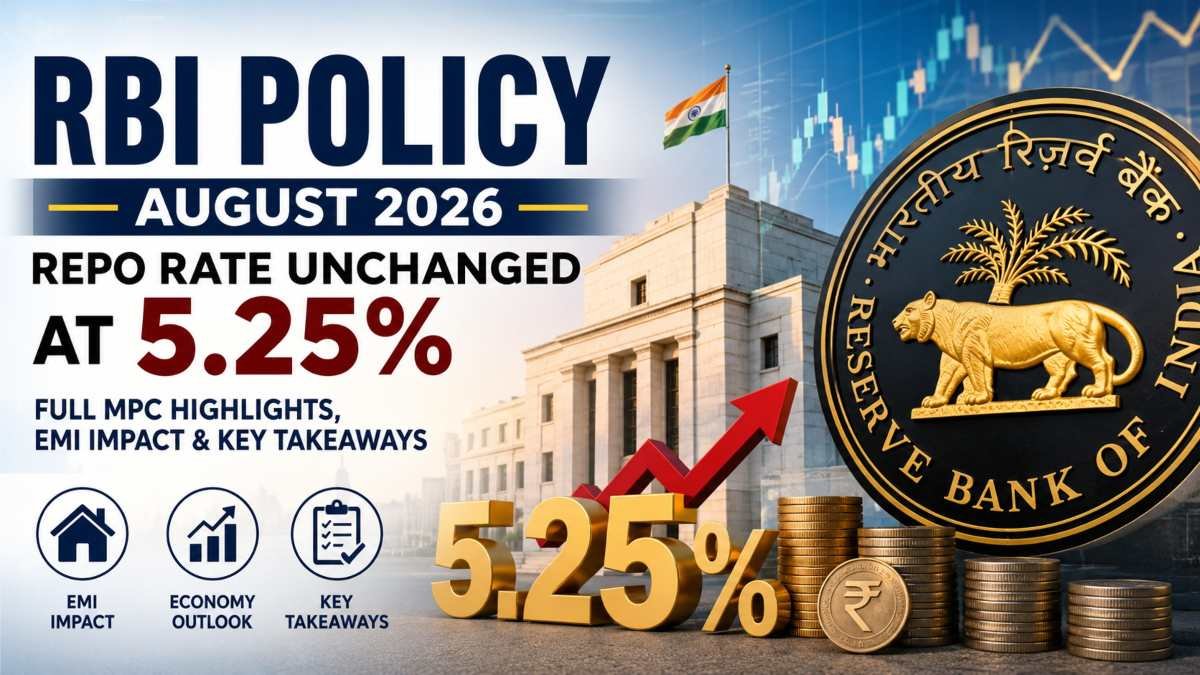
RBI Policy August 2026: The Reserve Bank of India (RBI) has announced its latest monetary policy for August 2026, keeping the repo rate unchanged at 5.25%. The decision was taken unanimously by the six-member Monetary Policy Committee (MPC), reflecting the central bank’s cautious approach amid rising global uncertainties, crude oil price volatility and inflation concerns.
At the same time, the RBI has retained its neutral policy stance and revised India’s FY27 GDP growth forecast to 6.7%, indicating confidence in the country’s economic fundamentals while remaining alert to inflationary risks.
For borrowers, investors, businesses and taxpayers, this policy is important because it directly influences loan interest rates, EMIs, fixed deposit returns, inflation expectations and the overall direction of the Indian economy. In this article, we explain everything you need to know about the RBI Policy August 2026 in simple language.
Quick Information
| Particular | Details |
|---|---|
| Policy Announcement Date | 5 August 2026 |
| RBI Governor | Sanjay Malhotra |
| Repo Rate | 5.25% (Unchanged) |
| MPC Decision | Unanimous |
| Policy Stance | Neutral |
| FY27 GDP Forecast | 6.7% |
| Key Focus | Inflation control with economic growth |
| Impact on EMIs | No immediate change expected |
| Next MPC Policy | As per RBI monetary policy schedule |
What Happened in RBI’s August 2026 Monetary Policy?
The RBI’s Monetary Policy Committee met from 3 August to 5 August 2026 to review the country’s economic situation and decide whether any change in interest rates was necessary. After evaluating domestic and global economic conditions, the committee decided to leave the repo rate unchanged at 5.25%.
This means commercial banks can continue borrowing short-term funds from the RBI at the same rate. Since there has been no change in the benchmark lending rate, most borrowers are unlikely to see any immediate change in their home loan, car loan or personal loan EMIs.
The decision comes at a time when India’s economy continues to perform well despite uncertainties in the global market. Rising crude oil prices, geopolitical tensions and inflationary pressures remain major concerns, prompting the RBI to adopt a cautious “wait and watch” strategy rather than making any aggressive policy move.
Read Also:- What Is Quantitative Finance? Meaning, Careers, and Applications
Why Did RBI Keep the Repo Rate Unchanged?
One of the biggest questions after every monetary policy announcement is why the RBI decides to maintain or change interest rates.
This time, several economic factors influenced the decision.
Inflation Risks Are Still Present
Although inflation has remained relatively stable compared to previous years, the RBI believes that several external risks could push prices higher in the coming months.
Some of the major concerns include:
- Rising international crude oil prices
- Food inflation caused by uncertain weather conditions
- Global geopolitical tensions
- Supply chain disruptions
- Financial market volatility
Instead of increasing interest rates immediately, the RBI wants to monitor how these risks evolve before taking further action.
India’s Economy Continues to Show Strength
The central bank also highlighted that India’s domestic economy remains resilient.
Consumer spending has stayed healthy, infrastructure investment continues to improve, and business activity remains positive across several sectors. Because of these encouraging indicators, the RBI increased its GDP growth projection for FY27 from 6.6% to 6.7%.
This reflects confidence that India’s economy can continue growing even while facing global challenges.
Read Also:- Golden Rules of Accounts: A Simple Guide to Debit and Credit Principles
Key Decisions Taken by the Monetary Policy Committee (MPC)
Apart from keeping the repo rate unchanged, the RBI announced several important policy decisions that could influence India’s financial system over the coming months.
Repo Rate Remains at 5.25%
The policy repo rate remains unchanged at 5.25%, meaning banks’ borrowing costs from the RBI remain the same.
Neutral Policy Stance Continues
The RBI retained its neutral stance, indicating that future decisions will depend entirely on incoming economic data rather than following a fixed path of rate hikes or cuts.
GDP Growth Forecast Raised
The RBI revised India’s FY27 GDP growth estimate upward to 6.7%, reflecting stronger domestic demand and improved economic resilience.
Data-Driven Monetary Policy
The central bank emphasized that future policy decisions will continue to depend on:
- Inflation trends
- Global economic developments
- Oil prices
- Domestic demand
- Financial market conditions
This flexible approach allows the RBI to respond quickly if economic conditions change significantly.
What Does This Mean for Ordinary Citizens?
For most people, the immediate impact of this policy is stability.
Borrowers are unlikely to experience any sudden increase in their monthly EMIs, while businesses can continue planning investments without worrying about a sharp rise in borrowing costs.
At the same time, the RBI has made it clear that controlling inflation remains one of its top priorities. If inflation increases significantly in the coming months, the central bank may reconsider its policy stance during future MPC meetings.
For now, however, the message is clear: India’s economy remains on a stable growth path, but the RBI will continue monitoring global and domestic developments carefully before making any major policy changes.
Read Also:- How to Finance Heating and Air Conditioning: Smart & Affordable Options for Every Budget
Impact on Home Loan, Car Loan and Personal Loan EMIs
One of the biggest concerns for borrowers after every RBI monetary policy announcement is whether their monthly EMIs will increase or decrease. Since the RBI has decided to keep the repo rate unchanged at 5.25%, there is no immediate reason for banks to revise lending rates.
If your home loan is linked to the External Benchmark Lending Rate (EBLR), your EMI is expected to remain unchanged unless your bank independently changes its lending policy. Similarly, borrowers with floating-rate car loans and personal loans are also unlikely to see any immediate impact.
However, borrowers should remember that banks may still review their lending rates based on liquidity conditions, competition and operational costs. Therefore, while the RBI’s decision provides stability, the final lending rate always depends on individual financial institutions.
For people planning to purchase a house, this policy offers a stable borrowing environment. Buyers can compare loan offers from different banks and housing finance companies without worrying about a sudden increase in interest rates.
What Does This Mean for Fixed Deposit (FD) Investors?
The RBI’s decision is also important for people who invest in Fixed Deposits (FDs).
Since policy rates remain unchanged, banks are expected to maintain their current FD interest rates in the short term. Investors who are looking for guaranteed returns can continue to take advantage of existing deposit rates without expecting any major change immediately.
Senior citizens, who generally receive slightly higher FD interest rates, are also likely to benefit from the current stable interest rate environment.
Long-term investors should continue comparing FD rates across banks before making an investment decision because interest rates may vary depending on the bank and deposit tenure.
Read Also:- What is National Finance Commission? Role, Objectives & Impact
Impact on Businesses and MSMEs
Micro, Small and Medium Enterprises (MSMEs) play a significant role in India’s economy. A stable repo rate provides businesses with greater confidence while planning expansion, purchasing equipment or arranging working capital.
Businesses that rely on bank financing can continue their borrowing plans without facing higher financing costs. This is particularly beneficial for startups, manufacturers, retailers and service providers that depend on affordable credit for day-to-day operations.
Stable borrowing costs also encourage private investment, which can contribute to job creation and economic growth over the coming months.
RBI’s Inflation Outlook
Inflation remains one of the RBI’s biggest priorities.
Although inflation has moderated compared to previous years, the central bank continues to monitor several factors that could increase prices in the future. Rising global crude oil prices, uncertain weather conditions affecting food production, geopolitical conflicts and supply chain disruptions remain key risks.
By keeping the repo rate unchanged, the RBI aims to balance two important objectives—supporting economic growth while ensuring inflation remains under control.
The central bank has also indicated that future policy decisions will depend entirely on incoming economic data. If inflation rises sharply, the RBI may consider tightening monetary policy in future meetings. On the other hand, if inflation remains comfortably within the target range and growth slows, there could be room for supportive measures.
GDP Growth Forecast Signals Confidence
One of the most positive announcements in the August 2026 monetary policy was the improvement in India’s GDP growth forecast.
The RBI revised the FY27 GDP growth estimate to 6.7%, reflecting confidence in domestic demand, infrastructure development, government spending and private consumption.
A stronger GDP forecast indicates that India’s economy continues to remain one of the fastest-growing major economies in the world.
For businesses and investors, this sends a positive message that economic activity is expected to remain healthy despite global uncertainties.
Stock Market Reaction
Financial markets closely monitor every RBI policy announcement because interest rate decisions directly affect banking stocks, financial companies and overall investor sentiment.
Since the repo rate remained unchanged, market participants generally viewed the decision as a sign of policy stability. Banking, housing finance, automobile and real estate sectors are expected to benefit from predictable borrowing costs.
However, market movements also depend on global economic conditions, corporate earnings, foreign investment flows and geopolitical developments. Investors should avoid making investment decisions based solely on a single policy announcement.
What Should Borrowers and Investors Do Now?
The latest RBI policy does not require borrowers or investors to make any immediate financial changes. Instead, it provides an opportunity to review financial goals carefully.
Home loan borrowers should continue paying EMIs on time and explore refinancing options only if significantly better interest rates become available.
People planning to purchase property can compare home loan offers from different lenders before making a decision.
FD investors should compare interest rates across banks and choose deposit tenures that match their financial objectives.
Investors in mutual funds and equity markets should continue following a disciplined long-term investment strategy instead of reacting to short-term policy announcements.
Final Thoughts
The RBI Monetary Policy for August 2026 reflects a balanced and cautious approach. By keeping the repo rate unchanged at 5.25%, the central bank has provided stability to borrowers, businesses and investors while continuing to focus on inflation management and sustainable economic growth.
The upward revision in India’s GDP growth forecast highlights confidence in the country’s economic strength, while the neutral policy stance gives the RBI flexibility to respond quickly if global or domestic conditions change.
For ordinary citizens, the biggest takeaway is simple: there is no immediate impact on loan EMIs, borrowing costs remain stable, and the economy continues to show encouraging signs of growth. Going forward, inflation trends, global developments and future MPC meetings will play a crucial role in determining the direction of interest rates.
By staying informed and making well-planned financial decisions, borrowers, investors and businesses can take full advantage of the stable policy environment created by the RBI’s latest announcement.
Key Takeaways from RBI Policy August 2026
The August 2026 RBI Monetary Policy sends a clear message that the central bank is prioritizing economic stability while keeping a close watch on inflation. Instead of making sudden changes to interest rates, the RBI has chosen a balanced approach that supports both growth and price stability.
Some of the biggest takeaways from this policy are:
- The repo rate remains unchanged at 5.25%.
- The Monetary Policy Committee (MPC) has retained its neutral stance.
- India’s FY27 GDP growth forecast has been revised upward to 6.7%.
- Borrowers are unlikely to see any immediate change in their loan EMIs.
- Banks are expected to maintain current lending and deposit rates in the short term.
- Inflation will continue to be the RBI’s primary focus in upcoming policy meetings.
Overall, the policy reflects confidence in India’s economic outlook while remaining prepared for global economic uncertainties.
Expert Opinion
The RBI’s decision to keep the repo rate unchanged is widely viewed as a balanced move. With inflation showing signs of moderation but global risks still present, maintaining the current interest rate allows the central bank to support economic growth without creating additional inflationary pressure.
For businesses, stable borrowing costs provide confidence to continue investing and expanding operations. For consumers, the decision offers relief by reducing the likelihood of sudden increases in loan EMIs.
At the same time, investors should remember that future monetary policy decisions will depend on inflation trends, crude oil prices, global financial conditions and domestic economic data.
Who Will Benefit the Most?
The latest RBI policy is expected to benefit several groups.
Home loan borrowers can continue with their repayment plans without worrying about an immediate rise in monthly EMIs.
Businesses and MSMEs will benefit from stable borrowing costs, making it easier to plan future investments.
Property buyers may find the current interest rate environment favourable when applying for new housing loans.
Fixed Deposit investors are likely to continue receiving existing interest rates until banks revise them in response to future policy changes.
FAQs About RBI Policy August 2026
What is the RBI repo rate in August 2026?
The Reserve Bank of India has kept the repo rate unchanged at 5.25% in its August 2026 Monetary Policy meeting.
Why did the RBI keep the repo rate unchanged?
The RBI decided to maintain the current repo rate because it wants to balance economic growth with inflation control. Global uncertainties, rising crude oil prices and inflation risks influenced the decision.
Will my home loan EMI increase after the RBI policy?
No immediate increase is expected. Since the repo rate remains unchanged, most floating-rate home loans linked to external benchmarks are likely to continue with the existing EMI unless your lender changes its lending rate.
Will fixed deposit interest rates change?
Most banks are expected to maintain their current FD interest rates in the short term because the RBI has not changed the repo rate.
What is the Monetary Policy Committee (MPC)?
The Monetary Policy Committee is a six-member committee responsible for deciding the RBI’s policy interest rates. It aims to maintain price stability while supporting economic growth.
What does a neutral policy stance mean?
A neutral stance means the RBI has not committed to either increasing or decreasing interest rates in future meetings. Future decisions will depend on economic data and inflation trends.
How does the repo rate affect borrowers?
The repo rate influences the cost at which banks borrow money from the RBI. Changes in the repo rate can affect home loan, car loan, personal loan and business loan interest rates.
What is the impact of the RBI policy on the Indian economy?
The latest policy supports economic stability by keeping borrowing costs steady while allowing the RBI to monitor inflation and global economic developments before making future policy changes.
Final Conclusion About RBI Policy August 2026
The RBI Monetary Policy August 2026 reflects a careful and balanced approach toward managing India’s economy. By keeping the repo rate unchanged at 5.25%, the central bank has provided stability for borrowers, businesses and investors while continuing its focus on controlling inflation.
Although global economic uncertainties remain, India’s strong domestic demand, improving infrastructure and positive growth outlook have given the RBI confidence to maintain its current policy direction.
For individuals, the policy means there is no immediate change in home loan EMIs or borrowing costs. For businesses, it creates a predictable financial environment that supports investment and expansion. Investors can also benefit from the stability while keeping an eye on future monetary policy announcements.
As inflation, global markets and economic indicators continue to evolve, the RBI’s upcoming Monetary Policy Committee meetings will remain important for borrowers, taxpayers, investors and businesses across the country.
Staying informed about RBI policy decisions can help individuals make smarter financial choices, whether they are applying for a loan, investing in fixed deposits, planning business expansion or managing long-term wealth. Keeping track of these updates is essential for understanding how changes in monetary policy may influence personal finances and the broader Indian economy.
